
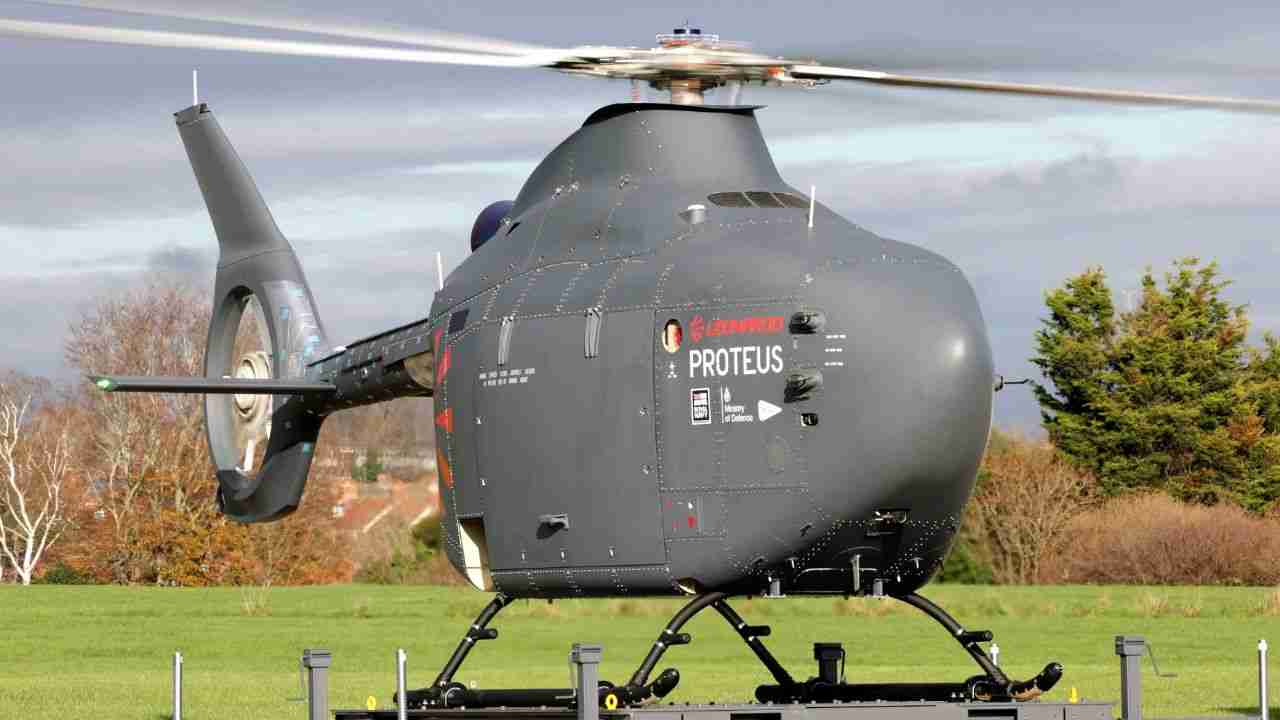
The Proteus helicopter, the Royal Navy’s first large-size unmanned model, has moved closer to its maiden flight after completing engine, systems and rotor tests at Leonardo facilities in the United Kingdom.
Developed under a US$79.2 million program, the demonstrator aims to establish the foundation for future autonomous vertical takeoff and landing aircraft, integrated into hybrid air wings composed of both manned and unmanned platforms.
Designed for complex maritime missions, Proteus incorporates AI-powered software, advanced sensors and systems capable of processing data entirely on board, even under strong winds and rough sea conditions. With the ability to carry around one ton of payload, the drone supports multiple roles, including surveillance, logistics and intelligence. Its first evaluation phase focuses on anti-submarine warfare, using sonobuoys and acoustic analysis to support ships, submarines and aircraft.
Although it has no pilot, the system remains under the control of an operator, in compliance with safety and engagement rules. The Royal Navy views the project as essential to understanding how medium-sized autonomous platforms should operate in the future and how they can complement manned aircraft in high-demand operational scenarios.
Source: UK Defence Journal | Photo: X @LDO_Helicopters | This content was created with the help of AI and reviewed by the editorial team.
Is it a bird? Is it a plane? No, it’s an autonomous aerial vehicle…
Proteus, the Royal Navy’s first full-size crewless helicopter is one step from its maiden flight after successful ground trials at @LDO_Helicopters in Yeovil. pic.twitter.com/rPUCyXtSfj
— Royal Navy (@RoyalNavy) December 2, 2025
